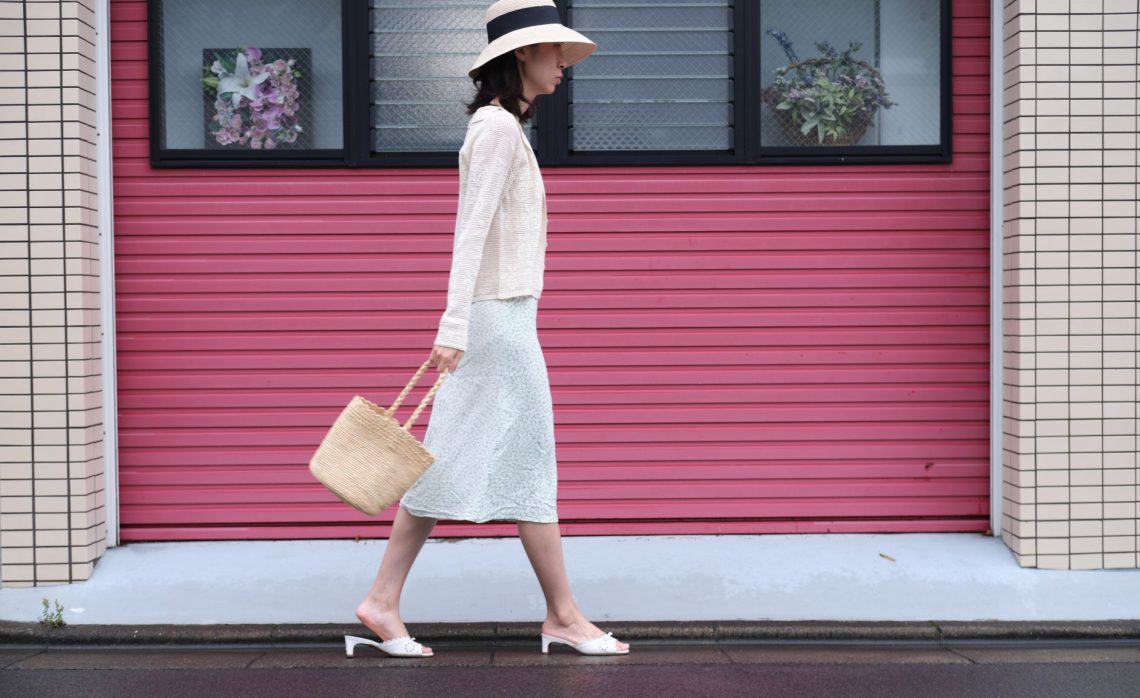
A midi skirt can be an excellent workwear staple: comfortable to sit in, easy to layer and polished enough to carry a simple top. Yet the same skirt can feel oddly theatrical when every other detail echoes its mood. A full skirt, fitted cardigan, round-toed heels and decorative belt might look lovely together, but the complete combination can suggest a character rather than your everyday wardrobe.
The answer is to give the skirt a clear role and let the rest of the outfit support it. Start with the hem, choose shoes that make sense beneath it, then add a knit with a deliberate shape. You do not need a perfectly coordinated set. You need clothes that sit comfortably together and suit the work you actually do.
Find your useful midi length
Midi covers a broad stretch between the knee and ankle, so do not assume every skirt labelled midi will work in the same way. A hem just below the knee feels different from one hovering above the ankle. Your height, the skirt’s volume and your usual shoes all affect where the length appears to finish.
Try the skirt with the shoes you expect to wear to work, standing naturally rather than stretching up in front of the mirror. Look for a hem that ends clearly, with enough space below it to show the shoe. If the fabric seems to gather visually around your lower legs, turn the hem up temporarily and compare. A small alteration can make a skirt feel much easier to wear.
There is no single correct point on the calf for everyone. Instead, check the whole outline: can you see the shape of the skirt, a section of leg or hosiery, and the footwear? With boots, the relationship changes, but the hem should still look intentional.
Check the skirt while moving
A work skirt needs to function away from the mirror. Sit down, climb a few steps and take a full stride. A narrow midi may need a vent or pleat for comfortable movement. A wrap skirt should stay securely overlapped when you sit. Check whether a lining twists, a waistband digs in or the hem catches your shoes before committing to a full day in it.
Let one part of the outfit set the mood
If your skirt has a strong personality, keep the neighbouring pieces straightforward. A flowing floral midi becomes more grounded with a plain crew-neck knit and loafers. A pleated skirt feels less formal with a fine-gauge jumper than with a silky blouse, elaborate necklace and delicate heels all at once.
This is particularly helpful with vintage-inspired shapes. You can enjoy a full skirt without repeating an entire period silhouette. Choose a simple leather bag, a modern-looking shoe or a relaxed knit, rather than adding every matching reference. Keep the detail you love and simplify around it.
For a quieter office outfit, start with a straight or gently flared skirt in navy, charcoal, olive or brown. These colours give you room to vary the texture of your knit without making the outfit feel busy. Prints work too; repeat one of their quieter colours in your top for an easy connection.
Choose shoes by shape, not just heel height
Heels are optional with a midi. What matters is how the shoe balances the amount of fabric above it. A very fine shoe can look overwhelmed beneath a heavy, wide skirt, while a substantial loafer can give that same skirt a useful sense of weight.
- Loafers: useful with straight, A-line and softly pleated skirts. Keep the knit fairly neat if both the skirt and shoe have volume.
- Pointed or almond-toed flats: a good partner for a longer hem when you want a clean finish. Make sure the toe shape gives your feet enough room.
- Block-heeled shoes: an option when you want some lift. A simple upper keeps the outfit adaptable for different office settings.
- Ankle boots: easiest when the gap between boot and skirt looks deliberate. Avoid a hem that repeatedly catches on the boot opening.
- Tall boots: can sit underneath a midi hem for a continuous line in colder weather. Check that the skirt moves freely over the shaft.
Use your workplace dress expectations as the final filter. Clean, understated trainers may suit a casual office, while a more formal setting may call for leather flats or closed-toe heels. If you change shoes after commuting, check the skirt with both pairs: a hem that clears one can drag with the other.
Give your knit a clear finishing point
The place where your jumper ends matters as much as its neckline. A long, loose knit over a wide midi can hide both garments’ shapes. That can be an enjoyable relaxed look, but for work it often benefits from a visible waistband or a more defined edge.
A fine knit is the simplest starting point because it tucks without creating much bulk. Try a crew neck with a printed skirt, a shallow V-neck with a plain A-line shape, or a lightweight roll neck when the weather cools. Leave enough ease to move your arms comfortably; the aim is a tidy outline, not a tight fit.
Choose your tuck to suit the waistband
For a flat waistband, tuck the knit evenly and gently lift a little fabric back out so it does not pull. With an elasticated waist, check that the tuck has not created a bulky ridge. A short jumper that finishes around the waistband may be more comfortable.
A small front tuck can work with a softly draped skirt, but look at the outfit from the side as well as the front. If the back hangs much lower and interrupts the skirt’s shape, try a full tuck or a shorter knit instead. You do not have to make every jumper work with every skirt.
Balance a chunky knit with a quieter skirt
A heavier jumper often sits best above a straight or bias-cut midi with relatively little volume. Let the hem of the knit rest naturally, then check that the skirt falls smoothly underneath. Avoid forcing a thick cable knit into a close-fitting waistband. A shorter cut gives you definition without the uncomfortable bundle of fabric.
Build three dependable weekday combinations
For a straightforward office day: pair a navy A-line midi with a cream fine-knit jumper and brown loafers. Tuck the jumper if the waistband sits comfortably, and add a simple bag. The gentle contrast gives the outfit definition without needing extra decoration.
For a meeting: try a charcoal straight midi, a softly fitted black knit and almond-toed flats or block heels. If you need a jacket, check that its hem does not fight with the jumper underneath. A smooth base makes the extra layer easier to manage.
For a more relaxed workplace: wear a small-print midi with a plain cardigan buttoned as a top. Choose a cardigan that finishes near the waist, and pair it with simple loafers. Keep any jewellery restrained so the print remains the main detail.
Make the final check practical
Before leaving, look at the outfit with your coat and work bag. A bulky shoulder bag can catch a loose knit, while a long coat may change how a full skirt moves. Check that tights feel comfortable at the waistband and that any slip stays above the hem when you walk.
If the combination still feels too dressed up, remove one decorative element or swap one piece for something plainer. Often the skirt itself needs no adjustment. A comfortable hem, a considered shoe and a knit that finishes in the right place are enough to make a midi feel at home in your working week.