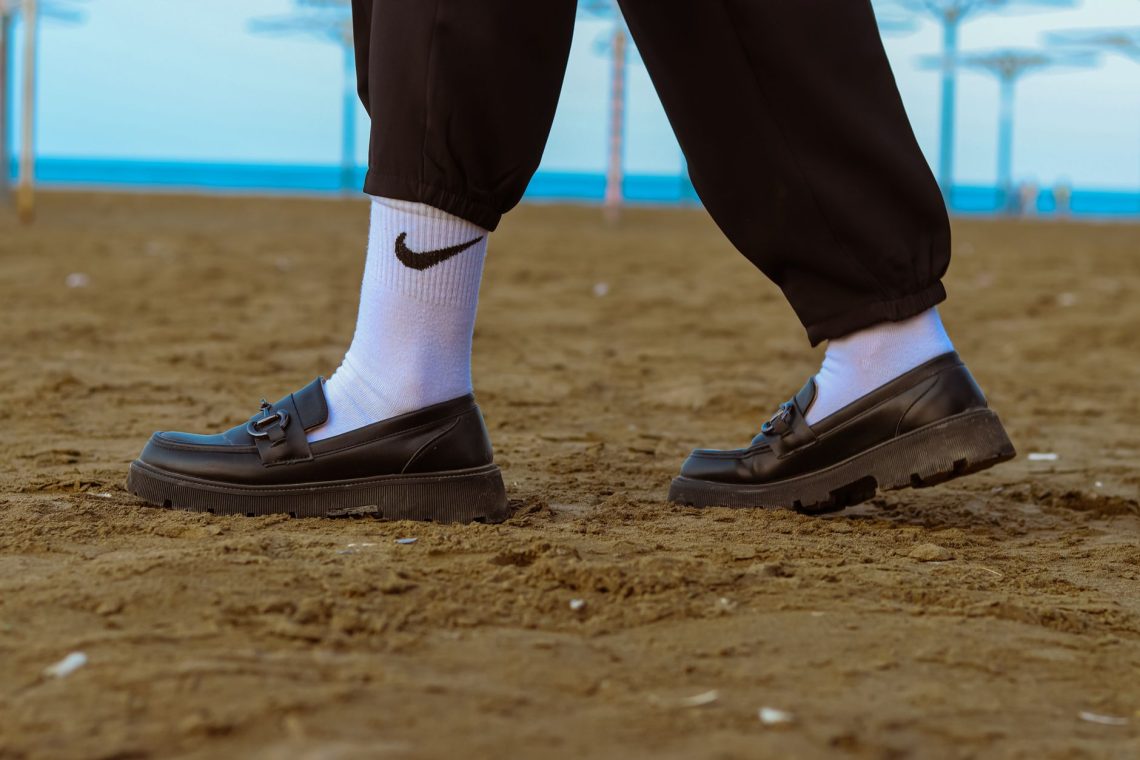
A loafer looks effortless until your sock starts gathering beneath your heel halfway down the street. You stop, pull it up and carry on, only to feel it slipping again. The answer is not always a tighter sock: the height of the opening, the shape of the heel and the fit of the shoe all matter.
Start by deciding whether you want your socks hidden or visible. Those are two different styling choices, with different fit requirements. A barely there liner needs enough coverage to stay anchored, while an ankle or crew sock needs a top that sits comfortably above the shoe. Here is how to choose both, with colour combinations that make the result look intentional.
Check where your loafers finish
Put on your loafers and look at the opening around your foot. Some have low sides and a short front; others cover much more of the instep. A sock described as suitable for loafers may still show above a low-cut pair, or offer too little coverage to stay secure inside a higher one.
The vamp is the upper section covering the top of your foot. Use its edge as a reference when choosing liners. You want the fabric to sit beneath that edge without having to stretch the sock unnaturally far down. At the back, the sock should cup your heel rather than balance on its lowest point.
Also check the shoe itself. If your heel lifts substantially with every step, the movement can tug at the sock. A thicker sock may take up a little space, but it should not be used to disguise a poor shoe fit. Equally, a loafer that squeezes your foot leaves little room for extra fabric.
Choose the right height for the effect you want
For a bare-ankle look, choose a shaped liner
A low-cut liner works best when its shape follows your foot and the shoe opening. Look for a defined heel pocket and enough fabric across the toes to avoid a narrow strip digging in. An extremely shallow liner can be discreet, but that discretion is no help if it repeatedly slides off.
If two liner shapes remain hidden, try the one with slightly more coverage first. A broader section over the forefoot and a deeper heel can give the sock more purchase. Check it from the side as well as from above: a liner can disappear beneath the vamp while peeping out beside the arch.
For visible socks, clear the back of the shoe
An ankle sock that finishes exactly against the loafer’s heel edge can feel awkward and look accidental. Choose a height that leaves a clear band of sock above the shoe instead. Walk and sit down before deciding; the cuff should remain visible as your ankle bends.
A crew sock is another straightforward option, particularly with cropped trousers, skirts or dresses. Its longer leg means you are not relying on a tiny heel section to keep everything in place. Wear it smoothly or with a small, deliberate slouch, provided the fabric does not bunch inside the shoe.
Look for grip without uncomfortable pressure
For hidden liners, a grippy section inside the heel can help resist movement. Check where it sits: it needs to meet your skin when the heel pocket is properly positioned. If the sock is too large and folds over, or too shallow to reach your heel securely, a grip strip cannot make up for the shape.
Put liners on clean, dry feet and check that moisturiser has absorbed before dressing. Follow the care label when washing them, including any instructions concerning fabric conditioner or drying. Avoid assuming that every grip material can tolerate the same treatment.
With visible socks, pay attention to the cuff as well as the heel. It should hold the sock up without pinching or leaving you constantly aware of it. A ribbed leg can provide a flexible fit, but a firm cuff is not a reason to accept toes that feel cramped.
Get the size and thickness working together
Check the sock’s actual size range rather than choosing by appearance alone. A loose liner may wrinkle under the arch, while an overstretched one can pull forwards and drag the heel down. If you sit between sizes, compare how each fits around your heel and toes instead of automatically sizing down for grip.
Try socks with the loafers you intend to wear. Fine-gauge socks generally create less bulk in a close-fitting shoe. A thicker rib may suit a roomier loafer, but it still needs enough space at the toe and across the instep. You should not have to curl your toes or force your foot into place.
- Check the toe seam: it should lie flat rather than gather beneath your toes.
- Smooth the sole: remove any wrinkles before putting on the shoe.
- Position the heel: align the pocket with your heel before adjusting the cuff.
- Walk normally: take several steps and turn around, rather than judging the fit while standing still.
Choose colour according to what will show
Keep hidden socks discreet
If your liners are completely covered, colour is largely a personal preference. If a small edge sometimes shows, choose a shade close to your skin or your loafers. Skin-toned fabric can soften the interruption against a bare ankle; a shoe-matching shade can make a glimpse less conspicuous against the leather.
Check lighter loafers carefully. A dark liner visible around a pale shoe opening can draw more attention than expected. The solution may be a different cut, rather than a different colour: fabric that consistently escapes above the sides is not truly hidden.
Give visible socks a clear role
For an easy starting point, match socks loosely to your trousers. Navy socks beneath navy trousers create a continuous line above brown or burgundy loafers. Charcoal socks can do the same with grey tailoring. The shades do not need to be identical, but keeping them related makes the combination simple to wear.
Alternatively, connect the socks to another part of your outfit. Burgundy socks might echo a knitted top; cream socks can pick up a pale stripe in a shirt. One repeated colour is usually enough to make the choice feel considered.
White or cream socks with dark loafers create a stronger contrast. Keep the visible fabric fresh-looking and make the height deliberate, especially with cropped hems. If you prefer a quieter effect, try a soft grey, muted brown or deep navy before moving towards bright colours or bold patterns.
Use your hemline to finish the look
Try the whole outfit before settling on sock height. Cropped trousers expose the cuff, so check that it sits neatly when you walk. Longer trousers may reveal socks only when you sit down; a crew length can maintain coverage if you would rather avoid a gap of bare skin.
With a skirt or dress, look at the balance between the shoe, sock and hem. A fine rib gives a different effect from a chunky sports-style sock. Neither needs a complicated outfit around it, but the thickness must still work inside your loafers.
If the sock keeps slipping, change one thing
Begin by repositioning the heel and smoothing the fabric. If it slips again, try a liner with more heel coverage, then reassess the size. Notice whether the shoe is lifting away from your heel or whether the sock alone is moving; these point to different fit problems.
Once you find a shape that stays put, check it through a normal period of wear before buying more. The right choice should let you enjoy the clean shape of your loafers without stopping to retrieve your socks. Whether hidden or visible, a secure heel and a considered colour do most of the work.