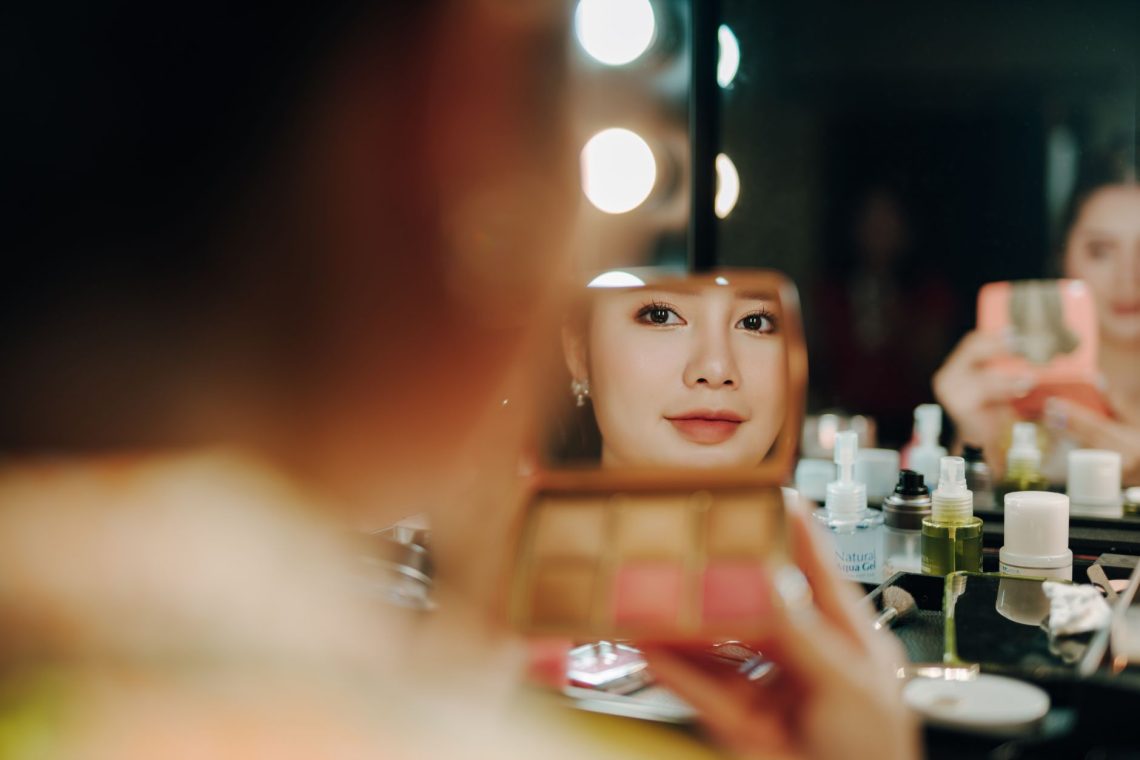
A makeup mirror with light should make getting ready simpler. Yet a bright reflection can still leave you wondering why your foundation looks different by the front door, or why the concealer you carefully blended suddenly seems heavy. Before blaming the makeup, look at where the light is coming from.
The position of your mirror matters as much as its lighting controls. A useful morning setup lets you see colour, coverage and edges without twisting towards a window or chasing every shadow with another layer of product. Here is how to choose a mirror and give it a sensible place in your routine.
Understand what overhead light is showing you
A ceiling light sends light down onto your face. Your brow bone, nose and chin interrupt it, creating shadows beneath them. Those shadows can make the area under your eyes look darker and the folds beside your nose look more pronounced. Looking into a mirror beneath a bright downlight does not remove that effect.
This matters when you apply concealer. You may keep adding coverage to an area that looks dark because it is in shadow, rather than because it needs more pigment. Once you move into light coming from in front of you, that extra makeup becomes easier to see.
Overhead light can also make it harder to judge whether blush is blended evenly or whether the edge of your foundation reaches your jaw cleanly. Keep the room light if it helps you move around comfortably, but give your face a separate, more even source of illumination.
Choose the position before choosing the mirror
Sit where you would actually do your makeup, with your brushes and everyday products within reach. Notice where you naturally hold your head and whether there is enough space for your elbows. A beautiful mirror that forces you to lean over a deep dressing table will quickly become irritating.
The centre of the mirror should sit roughly at eye level in your usual seated position. You want to look ahead with relaxed shoulders, rather than tip your chin up or bend your neck down. An adjustable stem or tilting head can help, especially if the table also serves as a desk.
Check that you can see your whole face and at least some of your neck together. That wider view is useful for judging foundation and the overall balance of your makeup. A small mirror can be handy for eyeliner, but it is less helpful as your only view when applying a full face.
Use the window in front of you
If you have a suitable window, try positioning the mirror so that you face towards it. Place a tabletop mirror where it does not block most of the incoming light. Soft daylight falling across the front of your face gives you a useful reference for colour and blending.
A window directly behind you leaves your face relatively shaded. A window far to one side can make one cheek look brighter than the other. If that is your only option, turn towards it briefly when checking your base, rather than assuming the darker side needs extra concealer.
Direct sunshine is not the same as soft daylight. If sunlight creates sharp patches across your face, move back or use a sheer curtain to diffuse it. Your aim is an easy view of your makeup, without squinting or constantly adjusting your position.
Look for light that reaches both sides of your face
When daylight is limited, illumination around the mirror or on both sides can help reduce the strong shadows produced by a single ceiling fitting. Look at how the light falls on your face, rather than judging a mirror by how striking its illuminated border looks.
A light placed only at the top may still leave shadows beneath your eyes. A small, very bright point can create glare. A broader, diffused light is generally more comfortable to work with, provided it illuminates your face clearly at your normal sitting distance.
If you can view a mirror before buying, sit or stand as you would at home. Look beneath your eyes, around your nostrils and along your jaw. Move your head slightly. You should be able to distinguish the edges of your makeup without having to tilt into one particular spot.
Make brightness and colour controls useful
Adjustable brightness helps you adapt the mirror to a dark morning or a room already filled with daylight. Start at a comfortable middle setting and increase it only if you cannot see clearly. Maximum brightness is not automatically the most useful setting; glare can make an otherwise suitable mirror unpleasant to use.
If the mirror offers warm, neutral and cool modes, compare them using your bare face and a familiar lipstick or blush. Very warm light can give everything a golden cast, while a strongly cool setting can make your reflection look noticeably different again. A neutral-looking setting is a practical starting point for everyday application.
Keep the surrounding lighting in mind, too. A warm bedside lamp on one side and a cooler mirror light in front can make colour judgement confusing. Try switching off the nearby lamp and see whether your face becomes easier to read. Consistency is more helpful than collecting several competing sources of light.
Keep magnification for specific jobs
Magnification is useful for seeing a stray brow hair, placing liner or checking a small area of concealer. It can also encourage you to concentrate on details that are barely visible at a normal conversational distance. Avoid making every decision about your base while looking into the magnified side.
Apply most of your makeup in the ordinary mirror, use magnification briefly when needed, then return to the wider view. Strong magnification often requires you to move closer to bring the reflection into focus, so check that this feels comfortable before making it an essential feature.
Check the everyday details before buying
- A steady base: the mirror should stay put when you adjust its angle or touch the controls.
- Useful adjustment: check the height and tilt against your dressing table and chair.
- Accessible controls: brightness settings should be easy to change without repeatedly touching the glass.
- A practical power arrangement: consider socket position, cable reach and whether a rechargeable mirror fits your habits.
- Room for your routine: leave space for an open makeup bag and the products you use each morning.
For a bathroom setup, choose a mirror intended for that location and follow its installation instructions. Keep portable electrical mirrors away from splashes, and avoid trailing a cable across a basin or walkway just to reach a better patch of light.
Build in one final daylight check
Before putting your makeup away, step back from the mirror. Check both cheeks, the edges around your nose and the transition between your jaw and neck. Turn your head gently so you can see whether blush or bronzer ends abruptly on either side.
When daylight is available, take a quick look near a window. If something seems wrong, identify the specific issue before adding more product. A visible foundation edge may need blending; a shadow beneath your eye may change when you face the light. They call for different responses.
On dark mornings, use the same comfortable mirror position and neutral-looking setting so your routine stays consistent. Check in daylight later when you have the chance, and use what you notice to refine your application next time. A dependable makeup mirror earns its place by helping you make clear decisions, with your face evenly lit and your posture relaxed.