A ponytail can keep hair out of your face while you sleep, yet leave a ruler-straight dent exactly where you do not want one. By morning, the lengths may look smooth above the band and kick out below it. Pulling the tie tighter usually makes that line more noticeable, even if the ponytail feels reassuringly secure at bedtime.
The aim is a looser hold for the morning: enough control to contain your hair, without pressing one narrow band into the same section all night. Your choice of tie matters, but so do the position, the number of wraps and whether your hair is fully dry. Here is how to put those details together.
Start with dry hair and a lighter hold
Hair can take on the shape it dries in, so putting damp lengths into a tight ponytail is an easy way to create a stubborn bend. Before tying up for bed, check the underneath layers and the hair at the nape, which may still feel damp after the surface has dried. Let those sections dry fully before gathering them.
If you wash late and your hair is still wet, skip the tightly tied overnight style. Allow time for drying, or adjust your washing routine when you can. A softer tie cannot compensate for wrapping damp hair firmly into place.
Brush or detangle gently using a method that suits your texture. Straight hair might need a light brush through; curls may be better arranged with your fingers to avoid disturbing their pattern. Remove any tangles that would tempt you to pull harder when gathering the hair.
Choose a tie that spreads the pressure
A thin, taut elastic concentrates its grip along a narrow line. A soft scrunchie with a broad fabric covering gives you more room to hold the hair gently. Look for a smooth surface, a comfortable amount of stretch and no exposed joins that catch as you slide it off.
Satin and silk scrunchies are options, but the fabric name alone does not guarantee a comfortable hold. A small scrunchie with a very tight elastic inside can still leave a mark. Test how it sits around your gathered hair: it should contain the lengths without squeezing them into a sharply pinched bundle.
- For fine hair: choose a lightweight scrunchie that stays put with minimal wrapping, rather than a heavy one that slips and encourages overtightening.
- For thick hair: use a larger opening so you do not have to force a bulky section through a small band.
- For curls: look for a smooth covering that releases easily without dragging through the curl pattern.
Spiral ties suit some people, but they can leave their own impressions or become awkward to remove. If yours consistently creates ridges, reserve it for daytime and try a broader, softer hold overnight.
Find a position you will not sleep on
Even a loose ponytail can crease when the tie is trapped between your head and pillow. Position it away from your usual resting point. A back sleeper may find a very loose gather near the crown more comfortable than a ponytail at the back of the head. A side sleeper should check that the tie does not sit against the pillow on their preferred side.
There is no single position that works for every length and texture. Try the arrangement while lying down before settling in. If you can feel a lump, pulling or pressure at the roots, move it or take it out. Comfort is a useful guide; an overnight style should not need enduring.
Try a loose high gather
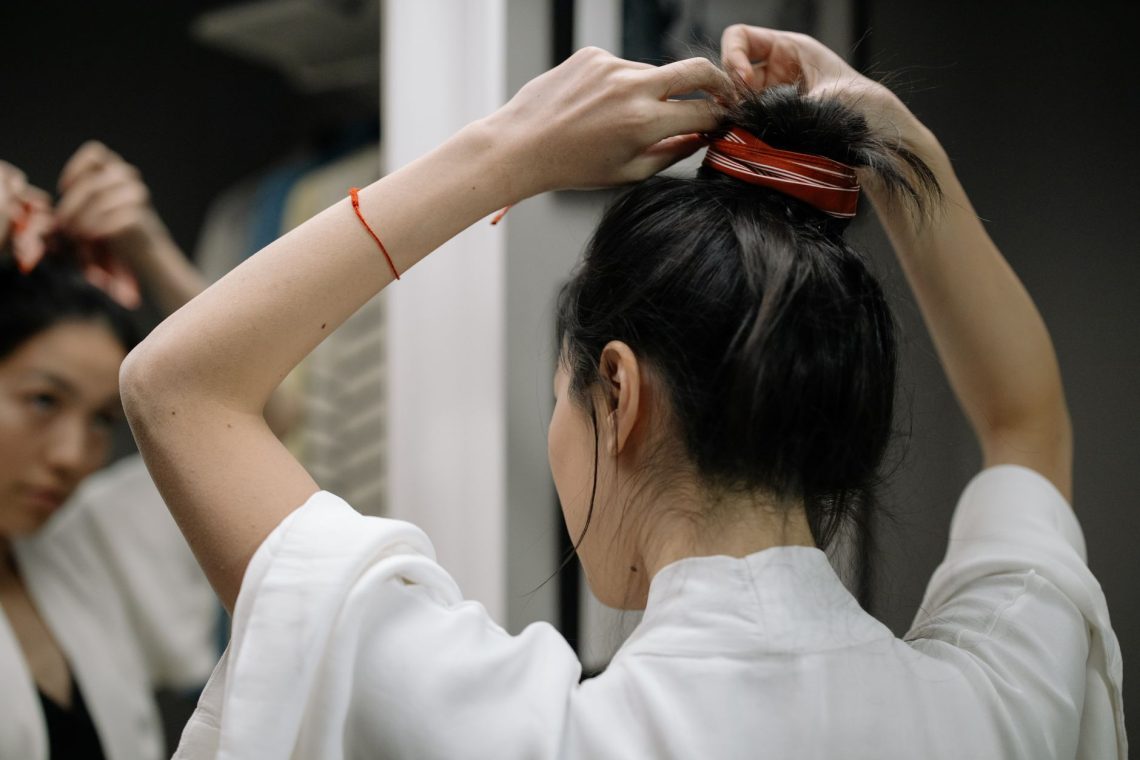
For hair long enough to reach the crown comfortably, lean forwards and bring the lengths together with your hands. Place the scrunchie around them with the fewest wraps needed to keep the bundle contained. Leave some slack at the roots rather than smoothing everything tightly upwards.
Curly hair is sometimes gathered this way to keep the lengths above the pillow. Keep the curls loose beyond the scrunchie and avoid pulling shorter sections until they stretch. If the front or nape feels strained, the position is too high for your current length.
Try a low, loose arrangement
If a high gather pulls at your roots, collect the hair low and slightly to one side, provided that keeps the tie clear of where you sleep. Let the band rest loosely rather than cinching it towards the scalp. This can suit longer hair, although restless sleepers may find it moves around.
Use fewer wraps, then check the tension
It is tempting to add one more turn of elastic because the first arrangement feels less secure than a daytime ponytail. For bedtime, that extra turn may be exactly what creates the dent. Start with the loosest workable wrap and resist aiming for a neat, lifted finish.
- Gather your dry hair gently in your chosen position.
- Slip the scrunchie over it without pulling the lengths taut.
- Add another wrap only if the tie immediately slides away.
- Ease a little hair back towards the scalp to release tension.
- Lie down and check that neither the band nor the roots feel under pressure.
If the tie falls out unless it is wrapped tightly, change its size or try a different arrangement. Do not keep increasing tension to make an unsuitable tie work. The goal is gentle containment, so a slightly untidy result is perfectly useful.
Decide whether a braid or no tie suits you better
A loose braid can keep long hair together without placing a band halfway down the lengths. Begin it loosely below the nape and secure the end with a soft tie. However, a braid will usually add some wave, so choose this option when a softly textured finish fits your morning plans.
If you want to preserve a straighter finish, leaving the hair untied may work better. Arrange the lengths above your pillow or use a comfortably fitted satin bonnet to contain them. Check that any bonnet band feels gentle around the hairline and does not leave pressure marks.
For shorter styles, forcing every section into a ponytail can create awkward bends and tug at the edges. Leaving the hair loose is often simpler. Avoid sleeping with hard clips, pins or bulky claw clips pressing against your head.
Make small adjustments for your hair texture
Fine or very straight hair can show even a faint change in direction. Prioritise a broad, loose tie and avoid fastening it where you want a smooth fall around the face. If every overnight ponytail leaves a line, try sleeping without one.
Wavy or curly hair may benefit from keeping the lengths loosely contained, but a band can still flatten the section it touches. Preserve some space around the gather and avoid repeatedly tightening it. In the morning, release the tie before separating or arranging the curls.
Thick, long or coily hair may feel heavy when gathered in one high bundle. If it pulls, try two loose sections or comfortable fabric containment instead. Notice where each fastening sits: dividing the hair is only helpful if both sections remain relaxed.
Release gently and soften any remaining bend
In the morning, unwind the scrunchie rather than dragging it down the full length of your hair. Let the hair settle before deciding how much correction it needs. Sometimes a gentle rearrangement with your fingers is enough.
For a visible dent, lightly dampen the affected section and reshape it as it dries. On straight styles, guide the hair in its intended direction with a brush and gentle airflow, using heat protection if you use heat. For curls, smooth damp hands over the compressed area and reshape the curl without brushing through the whole style.
Change one detail the following night: fewer wraps, a different position or a larger scrunchie. That makes it easier to see what helps. A comfortable, loosely contained style gives you a better chance of waking with hair that needs a quick arrangement rather than a complete restyle.