The common mistake is assuming a high price means a garment will last ten years. It does not. A costly T-shirt with a weak collar, poor fit, or delicate fabric can look tired after one season, while a modestly priced shirt with strong seams and a useful cut may survive years of washing. Long-lasting basics come from construction, fabric choice, fit, and care working together, not from a famous label alone. My verdict is simple: inspect the garment before you admire the brand, and buy the piece that can handle repeated wear, washing, and small repairs. That approach saves more money than chasing luxury logos, seasonal colors, or oversized wardrobes filled with clothes you rarely reach for.
Why expensive basics still fail
A decade-long wardrobe basic must solve a simple problem: it needs to perform the same job many times without becoming uncomfortable, misshapen, or visually dated. The strongest garment is not always the thickest one. A heavy fabric can still shrink badly, trap heat, or split at a low-quality seam. A lightweight piece can last for years when the yarn, stitching, and finishing are sound.
Most failures start with a mismatch between the garment and its job. A thin fashion tee will not become a reliable undershirt through wishful thinking. A soft, loosely knitted sweater may feel wonderful in a fitting room but pill quickly under a coat. A pair of rigid jeans may look impressive on day one and remain untouched in the closet because the fit makes sitting uncomfortable. The best basic is the one you will wear often enough to justify its cost. Before buying, ask where the item will be worn, how often it will be washed, and what stress it will face. If the answer exposes a weak point, leave it on the rack.
Use this fabric and construction check before buying

Run the same inspection every time. The table below gives useful benchmarks, but fabric performance still depends on the weave, finish, and care label.
| Garment area | Strong signs | Warning signs |
|---|---|---|
| T-shirt fabric | 180–240 GSM jersey, even surface, firm recovery | Thin see-through knit, twisting side seams, loose collar rib |
| Shirt seams | Clean straight stitching, about 10–12 stitches per inch | Skipped stitches, puckering, raw edges inside |
| Denim | 12–14 oz cotton denim, secure belt loops, reinforced pockets | Loose rivets, weak crotch stitching, stretch that feels rubbery |
| Buttons and zippers | Reinforced buttonholes, metal zipper with smooth travel | Shaking buttons, frayed buttonhole threads, sticky zipper |
Use price as a clue, not proof
For reference, the Uniqlo Supima Cotton T-Shirt often sits near $20 and makes a sensible low-cost baseline, but its longevity depends heavily on washing and rotation. The Lady White Co. Lite Jersey T-Shirt costs roughly $95 and offers denser construction for buyers who want a more substantial tee. The price gap is real, yet the expensive option only wins if its cut suits your wardrobe and you wear it often. A $20 shirt worn 100 times costs 20 cents per wear; a $95 shirt worn 500 times costs 19 cents. That is the better comparison.
Six fitting tests that prevent bad purchases
My strongest shopping rule is to test movement before checking the mirror. A basic that cannot move with you will not become a favorite, no matter how attractive the color looks.
- Check the shoulder line. On a shirt or jacket, the seam should sit close to the end of your shoulder. A dropped seam can be intentional, but an accidental oversized fit creates extra strain around the armhole.
- Raise both arms. Lift, reach, and cross your arms. If the whole garment rides sharply upward, the armhole or torso length may be wrong.
- Sit down. Test jeans, trousers, and skirts in a chair or fitting-room bench. Waistbands that cut in while sitting will keep the garment out of your regular rotation.
- Pinch the fabric. Look for enough ease to move without large folds. If the fabric pulls across the chest, hips, or seat, sizing up may solve the problem better than hoping the fibers relax.
- Inspect the care label. A garment that requires dry cleaning after every wear is not a practical daily basic for most wardrobes. Machine-washable fabric usually offers better value.
- Plan the repair. Ask if a tailor could replace the zipper, tighten a hem, or sew a loose seam. If one small fault would make the item impossible to save, do not buy it.
These tests also expose the most common mistake: buying for the body you imagine having later. Buy for the body and lifestyle you have now. A durable item must earn regular use before it can earn a place in your wardrobe.
Which materials make the best decade-long basics?
My clear recommendation is to choose sturdy natural fibers for high-use pieces, with a small amount of stretch only when movement requires it. Fabric choice sets the limits, but it does not decide the entire result.
Choose cotton jersey for everyday T-shirts
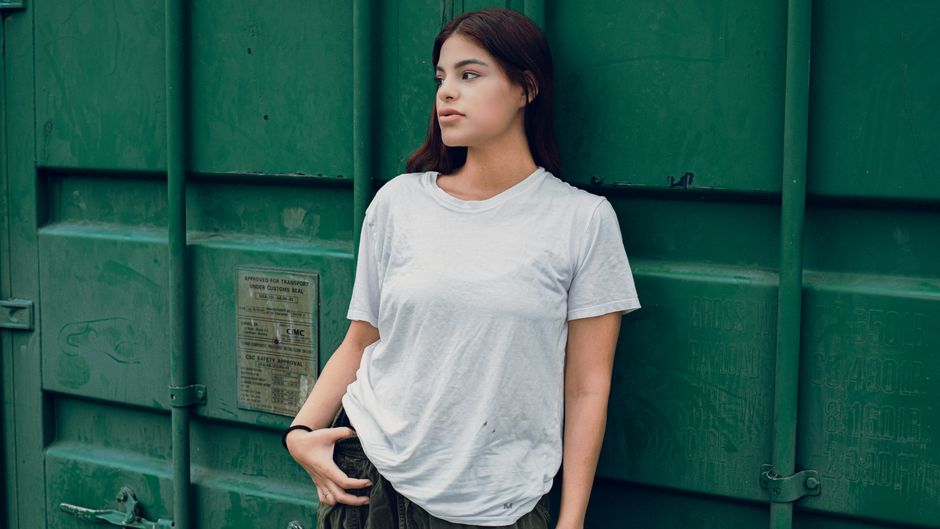
For T-shirts, combed cotton or Supima cotton with a firm 180–240 GSM knit gives the best balance of comfort, breathability, and shape retention. The Uniqlo Supima Cotton T-Shirt is a good budget test because it shows how far a clean, simple tee can go at about $20. For a heavier, more structured option, the Lady White Co. Lite Jersey T-Shirt at roughly $95 is my better pick when you want the shirt to hold its shoulder line under repeated wear. Avoid extremely soft, loose jersey if the collar already ripples on the hanger.
Choose wool carefully for sweaters
Wool can last a decade, but softness alone is a poor buying guide. Merino wool feels comfortable against the skin, while lambswool and sturdy Shetland wool often handle outer-layer use better. Look at the knit density and the area under the arms. A sweater with a loose halo of fibers may pill quickly against a coat. I would rather buy a slightly firmer wool sweater that needs an undershirt than a feather-soft knit that demands constant shaving and delicate storage.
Choose denim by weight and repair access
For jeans, 12–14 oz denim provides a strong starting point, but fit matters more than bragging rights about fabric weight. The Levi’s 501 Original, often priced around $80 in its standard cotton versions, remains a practical benchmark because the cut is familiar, replacement pairs are easy to find, and many tailors can repair the hem or crotch. Stretch denim is useful for comfort, yet a high elastane percentage can lose recovery sooner. For everyday jeans, I prefer mostly cotton with just enough stretch to sit and walk comfortably.
Questions that reveal the real value of a basic

Is a $20 shirt ever worth buying?
Yes, when it fits well, has even stitching, and will be worn frequently. A low price is not an automatic quality failure. The problem is buying five cheap shirts because each one feels disposable. One Uniqlo Supima Cotton T-Shirt that survives a full rotation can be a smarter purchase than several thin tees that twist after a few washes. My verdict: buy the $20 option for testing a color or silhouette, then spend more only on the styles you wear constantly.
Should every decade-long basic be 100% cotton?
No. A small amount of elastane improves comfort in trousers and jeans, and nylon can add useful strength to socks or outerwear. The mistake is treating a fiber label as a complete quality score. A 100% cotton shirt with weak seams will fail faster than a cotton blend with better construction. Check the fabric feel, seam security, recovery, and care instructions together.
When should you skip a supposedly durable garment?
Skip it when the fit is wrong, the care routine is unrealistic, or the design depends on a short-lived trend. A garment can be technically strong and still be a bad basic if you dislike wearing it. The best decade-long wardrobe will contain fewer pieces, but each one will solve a repeated dressing problem. In the years ahead, clothing quality will matter less as a luxury signal and more as a record of how well a garment earns its place.”